QTransformclass specifies 2D transformations of a coordinate system. 更多 …
def
__add__
(, n)
def
__div__
(, n)
def
__eq__
(arg__1)
def
__iadd__
(div)
def
__idiv__
(div)
def
__imul__
(arg__1)
def
__imul__
(div)
def
__isub__
(div)
def
__mul__
(, n)
def
__mul__
(o)
def
__ne__
(arg__1)
def
__reduce__
()
def
__repr__
()
def
__sub__
(, n)
def
adjoint
()
def
det
()
def
determinant
()
def
dx
()
def
dy
()
def
inverted
()
def
isAffine
()
def
isIdentity
()
def
isInvertible
()
def
isRotating
()
def
isScaling
()
def
isTranslating
()
def
m11
()
def
m12
()
def
m13
()
def
m21
()
def
m22
()
def
m23
()
def
m31
()
def
m32
()
def
m33
()
def
map
(a)
def
map
(a)
def
map
(l)
def
map
(l)
def
map
(p)
def
map
(p)
def
map
(p)
def
map
(r)
def
map
(x, y)
def
mapRect
(arg__1)
def
mapRect
(arg__1)
def
mapToPolygon
(r)
def
reset
()
def
rotate
(a[, axis=Qt.ZAxis])
def
rotateRadians
(a[, axis=Qt.ZAxis])
def
scale
(sx, sy)
def
setMatrix
(m11, m12, m13, m21, m22, m23, m31, m32, m33)
def
shear
(sh, sv)
def
toAffine
()
def
translate
(dx, dy)
def
transposed
()
def
type
()
def
fromScale
(dx, dy)
def
fromTranslate
(dx, dy)
def
quadToQuad
(arg__1, arg__2)
def
quadToQuad
(one, two, result)
def
quadToSquare
(arg__1)
def
quadToSquare
(quad, result)
def
squareToQuad
(arg__1)
def
squareToQuad
(square, result)
A transformation specifies how to translate, scale, shear, rotate or project the coordinate system, and is typically used when rendering graphics.
QTransformdiffers fromQMatrixin that it is a true 3x3 matrix, allowing perspective transformations.QTransform‘stoAffine()method allows castingQTransformtoQMatrix. If a perspective transformation has been specified on the matrix, then the conversion will cause loss of data.
QTransformis the recommended transformation class in Qt.A
QTransformobject can be built using thesetMatrix(),scale(),rotate(),translate()andshear()functions. Alternatively, it can be built by applyingbasic matrix operations. The matrix can also be defined when constructed, and it can be reset to the identity matrix (the default) using thereset()函数。
QTransformclass supports mapping of graphic primitives: A given point, line, polygon, region, or painter path can be mapped to the coordinate system defined by this matrix using themap()function. In case of a rectangle, its coordinates can be transformed using themapRect()function. A rectangle can also be transformed into a polygon (mapped to the coordinate system defined by this matrix), using themapToPolygon()函数。
QTransformprovides theisIdentity()function which returnstrueif the matrix is the identity matrix, and theisInvertible()function which returnstrueif the matrix is non-singular (i.e. AB = BA = I). Theinverted()function returns an inverted copy of this matrix if it is invertible (otherwise it returns the identity matrix), andadjoint()returns the matrix’s classical adjoint. In addition,QTransformprovides thedeterminant()function which returns the matrix’s determinant.Finally, the
QTransformclass supports matrix multiplication, addition and subtraction, and objects of the class can be streamed as well as compared.
When rendering graphics, the matrix defines the transformations but the actual transformation is performed by the drawing routines in
QPainter.默认情况下,
QPainteroperates on the associated device’s own coordinate system. The standard coordinate system of aQPaintDevicehas its origin located at the top-left position. The x values increase to the right; y values increase downward. For a complete description, see the coordinate system 文档编制。
QPainterhas functions to translate, scale, shear and rotate the coordinate system without using aQTransform。例如:
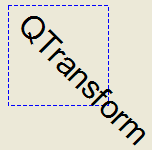
Although these functions are very convenient, it can be more efficient to build a
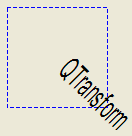
QTransform和调用setTransform()if you want to perform more than a single transform operation. For example:
A
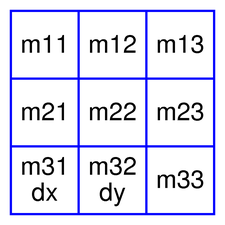
QTransformobject contains a 3 x 3 matrix. Them31(dx) andm32(dy) elements specify horizontal and vertical translation. Them11andm22elements specify horizontal and vertical scaling. Them21andm12elements specify horizontal and vertical shearing . And finally, them13andm23elements specify horizontal and vertical projection, withm33as an additional projection factor.
QTransformtransforms a point in the plane to another point using the following formulas:x' = m11*x + m21*y + dx y' = m22*y + m12*x + dy if is not affine: w' = m13*x + m23*y + m33 x' /= w' y' /= w'The point (x, y) is the original point, and (x’, y’) is the transformed point. (x’, y’) can be transformed back to (x, y) by performing the same operation on the
inverted()matrix.The various matrix elements can be set when constructing the matrix, or by using the
setMatrix()function later on. They can also be manipulated using thetranslate(),rotate(),scale()andshear()convenience functions. The currently set values can be retrieved using them11(),m12(),m13(),m21(),m22(),m23(),m31(),m32(),m33(),dx()anddy()函数。Translation is the simplest transformation. Setting
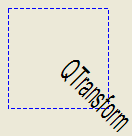
dxanddywill move the coordinate systemdxunits along the X axis anddyunits along the Y axis. Scaling can be done by settingm11andm22. For example, settingm11to 2 andm22to 1.5 will double the height and increase the width by 50%. The identity matrix hasm11,m22,和m33set to 1 (all others are set to 0) mapping a point to itself. Shearing is controlled bym12andm21. Setting these elements to values different from zero will twist the coordinate system. Rotation is achieved by setting both the shearing factors and the scaling factors. Perspective transformation is achieved by setting both the projection factors and the scaling factors.Here’s the combined transformations example using basic matrix operations:
QTransform

QTransform(mtx)
QTransform(other)
QTransform(h11, h12, h13, h21, h22, h23, h31, h32[, h33=1.0])
QTransform(h11, h12, h21, h22, dx, dy)
- param h32
qreal- param h33
qreal- param h21
qreal- param h22
qreal- param h23
qreal- param mtx
- param h11
qreal- param h12
qreal- param h13
qreal- param dx
qreal- param dy
qreal- param other
- param h31
qreal
构造恒等矩阵。
All elements are set to zero except
m11
and
m22
(specifying the scale) and
m33
which are set to 1.
另请参阅
reset()
构造矩阵采用元素
m11
,
m12
,
m13
,
m21
,
m22
,
m23
,
m31
,
m32
,
m33
.
另请参阅
setMatrix()
构造矩阵采用元素
m11
,
m12
,
m21
,
m22
,
dx
and
dy
.
另请参阅
setMatrix()
PySide2.QtGui.QTransform.
TransformationType

|
常量 |
描述 |
|---|---|
|
QTransform.TxNone |
|
|
QTransform.TxTranslate |
|
|
QTransform.TxScale |
|
|
QTransform.TxRotate |
|
|
QTransform.TxShear |
|
|
QTransform.TxProject |
PySide2.QtGui.QTransform.
__reduce__
(
)

PyObject
PySide2.QtGui.QTransform.
__repr__
(
)

PyObject
PySide2.QtGui.QTransform.
adjoint
(
)

Returns the adjoint of this matrix.
PySide2.QtGui.QTransform.
det
(
)

qreal
注意
此函数被弃用。
Returns the matrix’s determinant. Use
determinant()
代替。
PySide2.QtGui.QTransform.
determinant
(
)

qreal
Returns the matrix’s determinant.
PySide2.QtGui.QTransform.
dx
(
)

qreal
Returns the horizontal translation factor.
另请参阅
m31()
translate()
基本
Matrix
Operations
PySide2.QtGui.QTransform.
dy
(
)

qreal
Returns the vertical translation factor.
另请参阅
translate()
基本
Matrix
Operations
PySide2.QtGui.QTransform.
fromScale
(
dx
,
dy
)

dx
–
qreal
dy
–
qreal
Creates a matrix which corresponds to a scaling of
sx
horizontally and
sy
vertically. This is the same as
QTransform()
.scale(sx, sy) but slightly faster.
PySide2.QtGui.QTransform.
fromTranslate
(
dx
,
dy
)

dx
–
qreal
dy
–
qreal
Creates a matrix which corresponds to a translation of
dx
along the x axis and
dy
along the y axis. This is the same as
QTransform()
.translate(dx, dy) but slightly faster.
PySide2.QtGui.QTransform.
inverted
(
)

PyTuple
Returns an inverted copy of this matrix.
If the matrix is singular (not invertible), the returned matrix is the identity matrix. If
invertible
is valid (i.e. not 0), its value is set to true if the matrix is invertible, otherwise it is set to false.
另请参阅
isInvertible()
PySide2.QtGui.QTransform.
isAffine
(
)

bool
返回
true
if the matrix represent an affine transformation, otherwise returns
false
.
PySide2.QtGui.QTransform.
isIdentity
(
)

bool
返回
true
if the matrix is the identity matrix, otherwise returns
false
.
另请参阅
reset()
PySide2.QtGui.QTransform.
isInvertible
(
)

bool
返回
true
if the matrix is invertible, otherwise returns
false
.
另请参阅
inverted()
PySide2.QtGui.QTransform.
isRotating
(
)

bool
返回
true
if the matrix represents some kind of a rotating transformation, otherwise returns
false
.
注意
A rotation transformation of 180 degrees and/or 360 degrees is treated as a scaling transformation.
另请参阅
reset()
PySide2.QtGui.QTransform.
isScaling
(
)

bool
返回
true
if the matrix represents a scaling transformation, otherwise returns
false
.
另请参阅
reset()
PySide2.QtGui.QTransform.
isTranslating
(
)

bool
返回
true
if the matrix represents a translating transformation, otherwise returns
false
.
另请参阅
reset()
PySide2.QtGui.QTransform.
m11
(
)

qreal
Returns the horizontal scaling factor.
另请参阅
scale()
基本
Matrix
Operations
PySide2.QtGui.QTransform.
m12
(
)

qreal
Returns the vertical shearing factor.
另请参阅
shear()
基本
Matrix
Operations
PySide2.QtGui.QTransform.
m13
(
)

qreal
Returns the horizontal projection factor.
另请参阅
translate()
基本
Matrix
Operations
PySide2.QtGui.QTransform.
m21
(
)

qreal
Returns the horizontal shearing factor.
另请参阅
shear()
基本
Matrix
Operations
PySide2.QtGui.QTransform.
m22
(
)

qreal
Returns the vertical scaling factor.
另请参阅
scale()
基本
Matrix
Operations
PySide2.QtGui.QTransform.
m23
(
)

qreal
Returns the vertical projection factor.
另请参阅
translate()
基本
Matrix
Operations
PySide2.QtGui.QTransform.
m31
(
)

qreal
Returns the horizontal translation factor.
另请参阅
dx()
translate()
基本
Matrix
Operations
PySide2.QtGui.QTransform.
m32
(
)

qreal
Returns the vertical translation factor.
另请参阅
dy()
translate()
基本
Matrix
Operations
PySide2.QtGui.QTransform.
m33
(
)

qreal
Returns the division factor.
另请参阅
translate()
基本
Matrix
Operations
PySide2.QtGui.QTransform.
map
(
x
,
y
)

x
–
qreal
y
–
qreal
Maps the given coordinates
x
and
y
into the coordinate system defined by this matrix. The resulting values are put in *``tx`` and *``ty`` , respectively.
The coordinates are transformed using the following formulas:
x' = m11*x + m21*y + dx
y' = m22*y + m12*x + dy
if is not affine:
    w' = m13*x + m23*y + m33
    x' /= w'
    y' /= w'
The point (x, y) is the original point, and (x’, y’) is the transformed point.
另请参阅
														基本


														Matrix


														Operations
PySide2.QtGui.QTransform.
map
(
p
)

p
–
QPoint
QPoint
PySide2.QtGui.QTransform.
map
(
p
)

p
–
QPointF
QPointF
PySide2.QtGui.QTransform.
map
(
l
)

l
–
QLine
QLine
PySide2.QtGui.QTransform.
map
(
p
)

p
–
QPainterPath
PySide2.QtGui.QTransform.
map
(
l
)

l
–
QLineF
QLineF
PySide2.QtGui.QTransform.
mapRect
(
arg__1
)

arg__1
–
QRect
QRect
PySide2.QtGui.QTransform.
mapRect
(
arg__1
)

arg__1
–
QRectF
QRectF
PySide2.QtGui.QTransform.
mapToPolygon
(
r
)

r
–
QRect
创建和返回
QPolygon
representation of the given
rectangle
, mapped into the coordinate system defined by this matrix.
The rectangle’s coordinates are transformed using the following formulas:
x' = m11*x + m21*y + dx
y' = m22*y + m12*x + dy
if is not affine:
w' = m13*x + m23*y + m33
x' /= w'
y' /= w'
Polygons and rectangles behave slightly differently when transformed (due to integer rounding), so
matrix.map(QPolygon(rectangle))
is not always the same as
matrix.mapToPolygon(rectangle)
.
另请参阅
mapRect()
														基本


														Matrix


														Operations
PySide2.QtGui.QTransform.
__ne__
(
arg__1
)

arg__1
–
QTransform
bool
返回
true
if this matrix is not equal to the given
matrix
,否则返回
false
.
PySide2.QtGui.QTransform.
__mul__
(
n
)

n
–
qreal
PySide2.QtGui.QTransform.
__mul__
(
o
)

o
–
QTransform
Returns the result of multiplying this matrix by the given
matrix
.
Note that matrix multiplication is not commutative, i.e. a*b != b*a.
PySide2.QtGui.QTransform.
__imul__
(
arg__1
)

arg__1
–
QTransform
PySide2.QtGui.QTransform.
__imul__
(
div
)

div
–
qreal
这是重载函数。
Returns the result of performing an element-wise multiplication of this matrix with the given
scalar
.
PySide2.QtGui.QTransform.
__add__
(
n
)

n
–
qreal
PySide2.QtGui.QTransform.
__iadd__
(
div
)

div
–
qreal
这是重载函数。
Returns the matrix obtained by adding the given
scalar
to each element of this matrix.
PySide2.QtGui.QTransform.
__sub__
(
n
)

n
–
qreal
PySide2.QtGui.QTransform.
__isub__
(
div
)

div
–
qreal
这是重载函数。
Returns the matrix obtained by subtracting the given
scalar
from each element of this matrix.
PySide2.QtGui.QTransform.
__div__
(
n
)

n
–
qreal
PySide2.QtGui.QTransform.
__idiv__
(
div
)

div
–
qreal
这是重载函数。
Returns the result of performing an element-wise division of this matrix by the given
scalar
.
PySide2.QtGui.QTransform.
__eq__
(
arg__1
)

arg__1
–
QTransform
bool
返回
true
if this matrix is equal to the given
matrix
,否则返回
false
.
PySide2.QtGui.QTransform.
quadToQuad
(
arg__1
,
arg__2
)

PySide2.QtGui.QTransform.
quadToQuad
(
one
,
two
,
result
)

one
–
QPolygonF
two
–
QPolygonF
result
–
QTransform
bool
Creates a transformation matrix,
trans
, that maps a four-sided polygon,
one
, to another four-sided polygon,
two
。返回
true
if the transformation is possible; otherwise returns false.
This is a convenience method combining
quadToSquare()
and
squareToQuad()
methods. It allows the input quad to be transformed into any other quad.
另请参阅
squareToQuad()
quadToSquare()
PySide2.QtGui.QTransform.
quadToSquare
(
quad
,
result
)

quad
–
QPolygonF
result
–
QTransform
bool
Creates a transformation matrix,
trans
, that maps a four-sided polygon,
quad
, to a unit square. Returns
true
if the transformation is constructed or false if such a transformation does not exist.
另请参阅
squareToQuad()
quadToQuad()
PySide2.QtGui.QTransform.
reset
(
)

Resets the matrix to an identity matrix, i.e. all elements are set to zero, except
m11
and
m22
(specifying the scale) and
m33
which are set to 1.
另请参阅
QTransform()
isIdentity()
														基本


														Matrix


														Operations
PySide2.QtGui.QTransform.
rotate
(
a
[
,
axis=Qt.ZAxis
]
)

a
–
qreal
axis
–
Axis
Rotates the coordinate system counterclockwise by the given
angle
about the specified
axis
and returns a reference to the matrix.
Note that if you apply a
QTransform
to a point defined in widget coordinates, the direction of the rotation will be clockwise because the y-axis points downwards.
The angle is specified in degrees.
另请参阅
setMatrix()
PySide2.QtGui.QTransform.
rotateRadians
(
a
[
,
axis=Qt.ZAxis
]
)

a
–
qreal
axis
–
Axis
Rotates the coordinate system counterclockwise by the given
angle
about the specified
axis
and returns a reference to the matrix.
Note that if you apply a
QTransform
to a point defined in widget coordinates, the direction of the rotation will be clockwise because the y-axis points downwards.
The angle is specified in radians.
另请参阅
setMatrix()
PySide2.QtGui.QTransform.
scale
(
sx
,
sy
)

sx
–
qreal
sy
–
qreal
Scales the coordinate system by
sx
horizontally and
sy
vertically, and returns a reference to the matrix.
另请参阅
setMatrix()
PySide2.QtGui.QTransform.
setMatrix
(
m11
,
m12
,
m13
,
m21
,
m22
,
m23
,
m31
,
m32
,
m33
)

m11
–
qreal
m12
–
qreal
m13
–
qreal
m21
–
qreal
m22
–
qreal
m23
–
qreal
m31
–
qreal
m32
–
qreal
m33
–
qreal
Sets the matrix elements to the specified values,
m11
,
m12
,
m13
m21
,
m22
,
m23
m31
,
m32
and
m33
. Note that this function replaces the previous values.
QTransform
provides the
translate()
,
rotate()
,
scale()
and
shear()
convenience functions to manipulate the various matrix elements based on the currently defined coordinate system.
另请参阅
QTransform()
PySide2.QtGui.QTransform.
shear
(
sh
,
sv
)

sh
–
qreal
sv
–
qreal
Shears the coordinate system by
sh
horizontally and
sv
vertically, and returns a reference to the matrix.
另请参阅
setMatrix()
PySide2.QtGui.QTransform.
squareToQuad
(
square
,
result
)

square
–
QPolygonF
result
–
QTransform
bool
Creates a transformation matrix,
trans
, that maps a unit square to a four-sided polygon,
quad
。返回
true
if the transformation is constructed or false if such a transformation does not exist.
另请参阅
quadToSquare()
quadToQuad()
PySide2.QtGui.QTransform.
toAffine
(
)

返回
QTransform
as an affine matrix.
警告
If a perspective transformation has been specified, then the conversion will cause loss of data.
PySide2.QtGui.QTransform.
translate
(
dx
,
dy
)

dx
–
qreal
dy
–
qreal
Moves the coordinate system
dx
along the x axis and
dy
along the y axis, and returns a reference to the matrix.
另请参阅
setMatrix()
PySide2.QtGui.QTransform.
transposed
(
)

Returns the transpose of this matrix.
PySide2.QtGui.QTransform.
type
(
)

Returns the transformation type of this matrix.
The transformation type is the highest enumeration value capturing all of the matrix’s transformations. For example, if the matrix both scales and shears, the type would be
TxShear
, because
TxShear
has a higher enumeration value than
TxScale
.
Knowing the transformation type of a matrix is useful for optimization: you can often handle specific types more optimally than handling the generic case.
