QFontDialogclass provides a dialog widget for selecting a font. 更多 …

def
currentFont
()
def
open
(receiver, member)
def
options
()
def
selectedFont
()
def
setCurrentFont
(font)
def
setOption
(option[, on=true])
def
setOptions
(options)
def
testOption
(option)
def
currentFontChanged
(font)
def
fontSelected
(font)
字体对话框的创建是透过某一静态
getFont()函数。范例:
(ok, font) = QFontDialog.getFont(QFont("Helvetica [Cronyx]", 10), self)
if ok:
    # the user clicked OK and font is set to the font the user selected
else:
    # the user canceled the dialog; font is set to the initial
    # value, in this case Helvetica [Cronyx], 10
The dialog can also be used to set a widget’s font directly:
myWidget.setFont(QFontDialog.getFont(0, myWidget.font()))If the user clicks OK the font they chose will be used for myWidget, and if they click Cancel the original font is used.
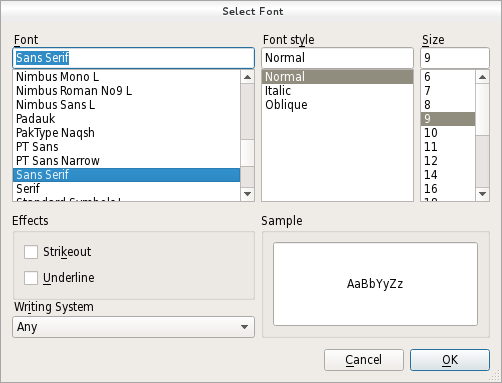
另请参阅
QFontQFontInfoQFontMetricsQColorDialogQFileDialog标准对话框范例
QFontDialog
(
[
parent=None
]
)

QFontDialog(initial[, parent=None])
- param parent
- param initial
QFont
Constructs a standard font dialog.
使用
setCurrentFont()
to set the initial font attributes.
parent
parameter is passed to the
QDialog
构造函数。
另请参阅
Constructs a standard font dialog with the given
parent
and specified
initial
font.
PySide2.QtWidgets.QFontDialog.
FontDialogOption

This enum specifies various options that affect the look and feel of a font dialog.
For instance, it allows to specify which type of font should be displayed. If none are specified all fonts available will be listed.
Note that the font filtering options might not be supported on some platforms (e.g. Mac). They are always supported by the non native dialog (used on Windows or Linux).
|
常量 |
描述 |
|---|---|
|
QFontDialog.NoButtons |
Don’t display OK and Cancel buttons. (Useful for “live dialogs”.) |
|
QFontDialog.DontUseNativeDialog |
Use Qt’s standard font dialog on the Mac instead of Apple’s native font panel. |
|
QFontDialog.ScalableFonts |
Show scalable fonts |
|
QFontDialog.NonScalableFonts |
Show non scalable fonts |
|
QFontDialog.MonospacedFonts |
Show monospaced fonts |
|
QFontDialog.ProportionalFonts |
Show proportional fonts |
另请参阅
options
setOption()
testOption()
PySide2.QtWidgets.QFontDialog.
currentFont
(
)

QFont
Returns the current font.
PySide2.QtWidgets.QFontDialog.
currentFontChanged
(
font
)

font
–
QFont
PySide2.QtWidgets.QFontDialog.
fontSelected
(
font
)

font
–
QFont
PySide2.QtWidgets.QFontDialog.
getFont
(
[
parent=None
]
)

parent
–
QWidget
PyTuple
这是重载函数。
执行模态字体对话框并返回字体。
If the user clicks OK, the selected font is returned. If the user clicks Cancel, the Qt default font is returned.
The dialog is constructed with the given
parent
。若
ok
parameter is not-null, the value it refers to is set to true if the user clicks OK, and false if the user clicks Cancel.
范例:
(ok, font) = QFontDialog.getFont(self)
if ok:
    # font is set to the font the user selected
else:
    # the user canceled the dialog; font is set to the default
    # application font, QApplication.font()
警告
Do not delete
parent
during the execution of the dialog. If you want to do this, you should create the dialog yourself using one of the
QFontDialog
构造函数。
PySide2.QtWidgets.QFontDialog.
getFont
(
initial
[
,
parent=None
[
,
title=""
[
,
options=QFontDialog.FontDialogOptions()
]
]
]
)

initial
–
QFont
parent
–
QWidget
title – unicode
options
–
FontDialogOptions
PyTuple
执行模态字体对话框并返回字体。
If the user clicks OK, the selected font is returned. If the user clicks Cancel, the
initial
font is returned.
The dialog is constructed with the given
parent
and the options specified in
options
.
title
is shown as the window title of the dialog and
initial
is the initially selected font. If the
ok
parameter is not-null, the value it refers to is set to true if the user clicks OK, and set to false if the user clicks Cancel.
范例:
(ok, font) = QFontDialog.getFont(QFont("Times", 12), self)
if ok:
    # font is set to the font the user selected
else:
    # the user canceled the dialog; font is set to the initial
    # value, in this case Times, 12.
The dialog can also be used to set a widget’s font directly:
myWidget.setFont(QFontDialog.getFont(0, myWidget.font()))
In this example, if the user clicks OK the font they chose will be used, and if they click Cancel the original font is used.
警告
Do not delete
parent
during the execution of the dialog. If you want to do this, you should create the dialog yourself using one of the
QFontDialog
构造函数。
PySide2.QtWidgets.QFontDialog.
open
(
receiver
,
member
)

receiver
–
QObject
member – str
打开对话框并连接其
fontSelected()
signal to the slot specified by
receiver
and
member
.
信号将断开槽连接,当对话框被关闭时。
PySide2.QtWidgets.QFontDialog.
options
(
)

FontDialogOptions
另请参阅
PySide2.QtWidgets.QFontDialog.
selectedFont
(
)

QFont
Returns the font that the user selected by clicking the OK or equivalent button.
注意
This font is not always the same as the font held by the
currentFont
property since the user can choose different fonts before finally selecting the one to use.
PySide2.QtWidgets.QFontDialog.
setCurrentFont
(
font
)

font
–
QFont
Sets the font highlighted in the
QFontDialog
到给定
font
.
PySide2.QtWidgets.QFontDialog.
setOption
(
option
[
,
on=true
]
)

option
–
FontDialogOption
on
–
bool
设置给定
option
to be enabled if
on
is true; otherwise, clears the given
option
.
另请参阅
options
testOption()
PySide2.QtWidgets.QFontDialog.
setOptions
(
options
)

options
–
FontDialogOptions
另请参阅
PySide2.QtWidgets.QFontDialog.
testOption
(
option
)

option
–
FontDialogOption
bool
返回
true
若给定
option
被启用;否则,返回 false。
另请参阅
options
setOption()
