QDockWidgetclass provides a widget that can be docked inside aQMainWindow或浮动在桌面上作为顶层窗口。 更多 …

def
allowedAreas
()
def
features
()
def
initStyleOption
(option)
def
isAreaAllowed
(area)
def
isFloating
()
def
setAllowedAreas
(areas)
def
setFeatures
(features)
def
setFloating
(floating)
def
setTitleBarWidget
(widget)
def
setWidget
(widget)
def
titleBarWidget
()
def
toggleViewAction
()
def
widget
()
def
allowedAreasChanged
(allowedAreas)
def
dockLocationChanged
(area)
def
featuresChanged
(features)
def
topLevelChanged
(topLevel)
def
visibilityChanged
(visible)
QDockWidgetprovides the concept of dock widgets, also know as tool palettes or utility windows. Dock windows are secondary windows placed in the dock widget area around thecentral widget在QMainWindow.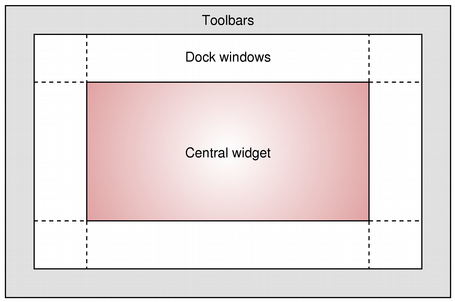
Dock windows can be moved inside their current area, moved into new areas and floated (e.g., undocked) by the end-user. The
QDockWidgetAPI allows the programmer to restrict the dock widgets ability to move, float and close, as well as the areas in which they can be placed.
A
QDockWidgetconsists of a title bar and the content area. The title bar displays the dock widgetswindow title, float button and a close button. Depending on the state of theQDockWidget, float and close buttons may be either disabled or not shown at all.The visual appearance of the title bar and buttons is dependent on the
stylein use.A
QDockWidgetacts as a wrapper for its child widget, set withsetWidget(). Custom size hints, minimum and maximum sizes and size policies should be implemented in the child widget.QDockWidgetwill respect them, adjusting its own constraints to include the frame and title. Size constraints should not be set on theQDockWidgetitself, because they change depending on whether it is docked; a dockedQDockWidgethas no frame and a smaller title bar.另请参阅
QDockWidget
(
[
parent=None
[
,
flags=Qt.WindowFlags()
]
]
)

QDockWidget(title[, parent=None[, flags=Qt.WindowFlags()]])
- param parent
- param title
unicode
- param flags
WindowFlags
构造
QDockWidget
采用父级
parent
和窗口标志
flags
. The dock widget will be placed in the left dock widget area.
构造
QDockWidget
采用父级
parent
和窗口标志
flags
. The dock widget will be placed in the left dock widget area.
窗口标题被设为
title
. This title is used when the
QDockWidget
is docked and undocked. It is also used in the context menu provided by
QMainWindow
.
另请参阅
PySide2.QtWidgets.QDockWidget.
DockWidgetFeature

|
常量 |
描述 |
|---|---|
|
QDockWidget.DockWidgetClosable |
The dock widget can be closed. On some systems the dock widget always has a close button when it’s floating (for example on MacOS 10.5). |
|
QDockWidget.DockWidgetMovable |
The dock widget can be moved between docks by the user. |
|
QDockWidget.DockWidgetFloatable |
The dock widget can be detached from the main window, and floated as an independent window. |
|
QDockWidget.DockWidgetVerticalTitleBar |
The dock widget displays a vertical title bar on its left side. This can be used to increase the amount of vertical space in a
|
|
QDockWidget.AllDockWidgetFeatures |
(Deprecated) The dock widget can be closed, moved, and floated. Since new features might be added in future releases, the look and behavior of dock widgets might change if you use this flag. Please specify individual flags instead. |
|
QDockWidget.NoDockWidgetFeatures |
The dock widget cannot be closed, moved, or floated. |
PySide2.QtWidgets.QDockWidget.
allowedAreas
(
)

DockWidgetAreas
另请参阅
PySide2.QtWidgets.QDockWidget.
allowedAreasChanged
(
allowedAreas
)

allowedAreas
–
DockWidgetAreas
PySide2.QtWidgets.QDockWidget.
dockLocationChanged
(
area
)

area
–
DockWidgetArea
PySide2.QtWidgets.QDockWidget.
features
(
)

DockWidgetFeatures
另请参阅
PySide2.QtWidgets.QDockWidget.
featuresChanged
(
features
)

features
–
DockWidgetFeatures
PySide2.QtWidgets.QDockWidget.
initStyleOption
(
option
)

option
–
QStyleOptionDockWidget
初始化
option
采用值来自此
QDockWidget
。此方法对子类是有用的,当需要
QStyleOptionDockWidget
, but don’t want to fill in all the information themselves.
另请参阅
PySide2.QtWidgets.QDockWidget.
isAreaAllowed
(
area
)

area
–
DockWidgetArea
bool
返回
true
if this dock widget can be placed in the given
area
;否则返回
false
.
PySide2.QtWidgets.QDockWidget.
isFloating
(
)

bool
PySide2.QtWidgets.QDockWidget.
setAllowedAreas
(
areas
)

areas
–
DockWidgetAreas
另请参阅
PySide2.QtWidgets.QDockWidget.
setFeatures
(
features
)

features
–
DockWidgetFeatures
另请参阅
PySide2.QtWidgets.QDockWidget.
setFloating
(
floating
)

floating
–
bool
另请参阅
PySide2.QtWidgets.QDockWidget.
setTitleBarWidget
(
widget
)

widget
–
QWidget
Sets an arbitrary
widget
as the dock widget’s title bar. If
widget
is
None
, any custom title bar widget previously set on the dock widget is removed, but not deleted, and the default title bar will be used instead.
If a title bar widget is set,
QDockWidget
will not use native window decorations when it is floated.
Here are some tips for implementing custom title bars:
Mouse events that are not explicitly handled by the title bar widget must be ignored by calling
ignore()
. These events then propagate to the
QDockWidget
parent, which handles them in the usual manner, moving when the title bar is dragged, docking and undocking when it is double-clicked, etc.
当
DockWidgetVerticalTitleBar
is set on
QDockWidget
, the title bar widget is repositioned accordingly. In
resizeEvent()
, the title bar should check what orientation it should assume:
dockWidget = parentWidget()
if dockWidget.features() & QDockWidget.DockWidgetVerticalTitleBar:
    # I need to be vertical
else:
    # I need to be horizontal
The title bar widget must have a valid
sizeHint()
and
minimumSizeHint()
. These functions should take into account the current orientation of the title bar.
It is not possible to remove a title bar from a dock widget. However, a similar effect can be achieved by setting a default constructed
QWidget
as the title bar widget.
使用
qobject_cast()
as shown above, the title bar widget has full access to its parent
QDockWidget
. Hence it can perform such operations as docking and hiding in response to user actions.
另请参阅
titleBarWidget()
DockWidgetVerticalTitleBar
PySide2.QtWidgets.QDockWidget.
setWidget
(
widget
)

widget
–
QWidget
Sets the widget for the dock widget to
widget
.
If the dock widget is visible when
widget
is added, you must
show()
it explicitly.
Note that you must add the layout of the
widget
before you call this function; if not, the
widget
will not be visible.
另请参阅
PySide2.QtWidgets.QDockWidget.
titleBarWidget
(
)

Returns the custom title bar widget set on the
QDockWidget
,或
None
if no custom title bar has been set.
另请参阅
PySide2.QtWidgets.QDockWidget.
toggleViewAction
(
)

Returns a checkable action that can be added to menus and toolbars so that the user can show or close this dock widget.
The action’s text is set to the dock widget’s window title.
注意
The action can not be used to programmatically show or hide the dock widget. Use the
visible
property for that.
另请参阅
text
windowTitle
PySide2.QtWidgets.QDockWidget.
topLevelChanged
(
topLevel
)

topLevel
–
bool
PySide2.QtWidgets.QDockWidget.
visibilityChanged
(
visible
)

visible
–
bool
PySide2.QtWidgets.QDockWidget.
widget
(
)

Returns the widget for the dock widget. This function returns zero if the widget has not been set.
另请参阅
