演示如何为网络服务创建服务器。
This example is intended to be run alongside the Fortune 客户端 example or the 阻塞 Fortune 客户端范例 .
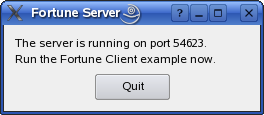
它使用
QTcpServerto accept incoming TCP connections, and a simpleQDataStreambased data transfer protocol to write a fortune to the connecting client (from the Fortune 客户端 example), before closing the connection.class Server : public QDialog { Q_OBJECT public: explicit Server(QWidget *parent = nullptr); private slots: void sendFortune(); private: void initServer(); QLabel *statusLabel = nullptr; QTcpServer *tcpServer = nullptr; QVector<QString> fortunes; };The server is implemented using a simple class with only one slot, for handling incoming connections.
tcpServer = new QTcpServer(this);
if (!tcpServer->listen()) {
    QMessageBox::critical(this, tr("Fortune Server"),
                          tr("Unable to start the server: %1.")
                          .arg(tcpServer->errorString()));
    close();
    return;
}
QString ipAddress;
QList<QHostAddress> ipAddressesList = QNetworkInterface::allAddresses();
// use the first non-localhost IPv4 address
for (int i = 0; i < ipAddressesList.size(); ++i) {
    if (ipAddressesList.at(i) != QHostAddress::LocalHost &&
        ipAddressesList.at(i).toIPv4Address()) {
        ipAddress = ipAddressesList.at(i).toString();
        break;
    }
}
// if we did not find one, use IPv4 localhost
if (ipAddress.isEmpty())
    ipAddress = QHostAddress(QHostAddress::LocalHost).toString();
statusLabel->setText(tr("The server is running on\n\nIP: %1\nport: %2\n\n"
                        "Run the Fortune Client example now.")
                     .arg(ipAddress).arg(tcpServer->serverPort()));
In its constructor, our Server object calls
listen()to set up aQTcpServerto listen on all addresses, on an arbitrary port. In then displays the portQTcpServerpicked in a label, so that user knows which port the fortune client should connect to.fortunes << tr("You've been leading a dog's life. Stay off the furniture.") << tr("You've got to think about tomorrow.") << tr("You will be surprised by a loud noise.") << tr("You will feel hungry again in another hour.") << tr("You might have mail.") << tr("You cannot kill time without injuring eternity.") << tr("Computers are not intelligent. They only think they are.");Our server generates a list of random fortunes that it can send to connecting clients.
connect(tcpServer, &QTcpServer::newConnection, this, &Server::sendFortune);When a client connects to our server,
QTcpServer将发射newConnection(). In turn, this will invoke our sendFortune() slot:void Server::sendFortune() { QByteArray block; QDataStream out(&block, QIODevice::WriteOnly); out.setVersion(QDataStream::Qt_5_10); out << fortunes[QRandomGenerator::global()->bounded(fortunes.size())];The purpose of this slot is to select a random line from our list of fortunes, encode it into a
QByteArray使用QDataStream, and then write it to the connecting socket. This is a common way to transfer binary data usingQTcpSocket. First we create aQByteArray和QDataStreamobject, passing the bytearray toQDataStream‘s constructor. We then explicitly set the protocol version ofQDataStreamtoQt_4_0to ensure that we can communicate with clients from future versions of Qt (seesetVersion()). We continue by streaming in a random fortune.QTcpSocket *clientConnection = tcpServer->nextPendingConnection(); connect(clientConnection, &QAbstractSocket::disconnected, clientConnection, &QObject::deleteLater);We then call
nextPendingConnection(),其返回QTcpSocketrepresenting the server side of the connection. By connectingdisconnected()todeleteLater(), we ensure that the socket will be deleted after disconnecting.clientConnection->write(block); clientConnection->disconnectFromHost(); }The encoded fortune is written using
write(), and we finally calldisconnectFromHost(), which will close the connection afterQTcpSockethas finished writing the fortune to the network. BecauseQTcpSocketworks asynchronously, the data will be written after this function returns, and control goes back to Qt’s event loop. The socket will then close, which in turn will causedeleteLater()to delete it.
