继承者: QConicalGradient , QLinearGradient , QRadialGradient
def
__eq__
(gradient)
def
__ne__
(other)
def
coordinateMode
()
def
interpolationMode
()
def
setColorAt
(pos, color)
def
setCoordinateMode
(mode)
def
setInterpolationMode
(mode)
def
setSpread
(spread)
def
setStops
(stops)
def
spread
()
def
stops
()
def
type
()
Qt currently supports three types of gradient fills:
Linear gradients interpolate colors between start and end points.
Simple radial gradients interpolate colors between a focal point and end points on a circle surrounding it.
Extended radial gradients interpolate colors between a center and a focal circle.
Conical gradients interpolate colors around a center point.
A gradient’s type can be retrieved using the
type()function. Each of the types is represented by a subclass ofQGradient:
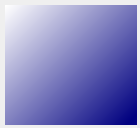
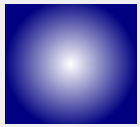
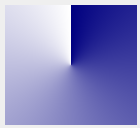
The colors in a gradient are defined using stop points of the
QGradientStoptype; i.e., a position and a color. Use thesetColorAt()function to define a single stop point. Alternatively, use thesetStops()function to define several stop points in one go. Note that the latter function replaces the current set of stop points.It is the gradient’s complete set of stop points (accessible through the
stops()function) that describes how the gradient area should be filled. If no stop points have been specified, a gradient of black at 0 to white at 1 is used.A diagonal linear gradient from black at (100, 100) to white at (200, 200) could be specified like this:
QLinearGradient linearGrad(QPointF(100, 100), QPointF(200, 200));
linearGrad.setColorAt(0, Qt::black);
linearGrad.setColorAt(1, Qt::white);
A gradient can have an arbitrary number of stop points. The following would create a radial gradient starting with red in the center, blue and then green on the edges:
QRadialGradient radialGrad(QPointF(100, 100), 100);
radialGrad.setColorAt(0, Qt::red);
radialGrad.setColorAt(0.5, Qt::blue);
radialGrad.setColorAt(1, Qt::green);
It is possible to repeat or reflect the gradient outside its area by specifiying the
spread 方法使用setSpread()function. The default is to pad the outside area with the color at the closest stop point. The currently setspread 方法can be retrieved using thespread()function. TheSpreadenum defines three different methods:
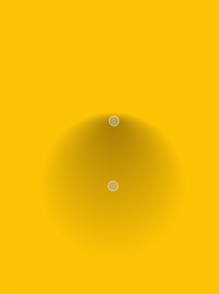
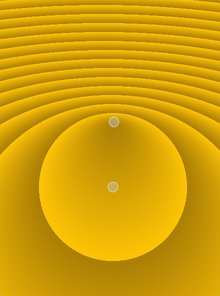
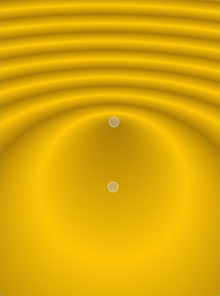
PadSpread
RepeatSpread
ReflectSpread注意:
setSpread()function only has effect for linear and radial gradients. The reason is that the conical gradient is closed by definition, i.e. the conical gradient fills the entire circle from 0 - 360 degrees, while the boundary of a radial or a linear gradient can be specified through its radius or final stop points, respectively.The gradient coordinates can be specified in logical coordinates, relative to device coordinates, or relative to object bounding box coordinates. The
												coordinate


												mode
can be set using thesetCoordinateMode()function. The default isLogicalMode, where the gradient coordinates are specified in the same way as the object coordinates. To retrieve the currently setcoordinate modeusecoordinateMode().
QGradient

QGradient(arg__1)
QGradient(QGradient)
- param arg__1
Preset- param QGradient
Constructs a gradient based on a predefined
preset
.
The coordinate mode of the resulting gradient is
ObjectMode
, allowing the preset to be applied to arbitrary object sizes.
PySide2.QtGui.QGradient.
Type

Specifies the type of gradient.
|
常量 |
描述 |
|---|---|
|
QGradient.LinearGradient |
Interpolates colors between start and end points (
|
|
QGradient.RadialGradient |
Interpolate colors between a focal point and end points on a circle surrounding it (
|
|
QGradient.ConicalGradient |
Interpolate colors around a center point (
|
|
QGradient.NoGradient |
No gradient is used. |
另请参阅
PySide2.QtGui.QGradient.
Spread

Specifies how the area outside the gradient area should be filled.
|
常量 |
描述 |
|---|---|
|
QGradient.PadSpread |
The area is filled with the closest stop color. This is the default. |
|
QGradient.RepeatSpread |
The gradient is repeated outside the gradient area. |
|
QGradient.ReflectSpread |
The gradient is reflected outside the gradient area. |
另请参阅
PySide2.QtGui.QGradient.
CoordinateMode

This enum specifies how gradient coordinates map to the paint device on which the gradient is used.
|
常量 |
描述 |
|---|---|
|
QGradient.LogicalMode |
This is the default mode. The gradient coordinates are specified logical space just like the object coordinates. |
|
QGradient.ObjectMode |
In this mode the gradient coordinates are relative to the bounding rectangle of the object being drawn, with (0,0) in the top left corner, and (1,1) in the bottom right corner of the object’s bounding rectangle. This value was added in Qt 5.12. |
|
QGradient.StretchToDeviceMode |
In this mode the gradient coordinates are relative to the bounding rectangle of the paint device, with (0,0) in the top left corner, and (1,1) in the bottom right corner of the paint device. |
|
QGradient.ObjectBoundingMode |
This mode is the same as , except that the {
|
PySide2.QtGui.QGradient.
InterpolationMode

|
常量 |
描述 |
|---|---|
|
QGradient.ComponentInterpolation |
The color components and the alpha component are independently linearly interpolated. |
|
QGradient.ColorInterpolation |
The colors are linearly interpolated in premultiplied color space. |
PySide2.QtGui.QGradient.
Preset

This enum specifies a set of predefined presets for
QGradient
, based on the gradients from
https://webgradients.com/
.
New in version 5.12.
PySide2.QtGui.QGradient.
coordinateMode
(
)

Returns the coordinate mode of this gradient. The default mode is
LogicalMode
.
另请参阅
PySide2.QtGui.QGradient.
interpolationMode
(
)

Returns the interpolation mode of this gradient. The default mode is .
PySide2.QtGui.QGradient.
__ne__
(
other
)

other
–
QGradient
bool
返回
true
if the gradient is the same as the other
gradient
specified; otherwise returns
false
.
另请参阅
operator==()
PySide2.QtGui.QGradient.
__eq__
(
gradient
)

gradient
–
QGradient
bool
返回
true
if the gradient is the same as the other
gradient
specified; otherwise returns
false
.
另请参阅
operator!=()
PySide2.QtGui.QGradient.
setColorAt
(
pos
,
color
)

pos
–
qreal
color
–
QColor
Creates a stop point at the given
position
采用给定
color
. The given
position
must be in the range 0 to 1.
另请参阅
PySide2.QtGui.QGradient.
setCoordinateMode
(
mode
)

mode
–
CoordinateMode
Sets the coordinate mode of this gradient to
mode
. The default mode is
LogicalMode
.
另请参阅
PySide2.QtGui.QGradient.
setInterpolationMode
(
mode
)

mode
–
InterpolationMode
Sets the interpolation mode of this gradient to
mode
. The default mode is .
PySide2.QtGui.QGradient.
setSpread
(
spread
)

spread
–
Spread
Specifies the spread
方法
that should be used for this gradient.
Note that this function only has effect for linear and radial gradients.
另请参阅
PySide2.QtGui.QGradient.
setStops
(
stops
)

stops –
Replaces the current set of stop points with the given
stopPoints
. The positions of the points must be in the range 0 to 1, and must be sorted with the lowest point first.
另请参阅
PySide2.QtGui.QGradient.
spread
(
)

Returns the spread method use by this gradient. The default is
PadSpread
.
另请参阅
PySide2.QtGui.QGradient.
stops
(
)

Returns the stop points for this gradient.
If no stop points have been specified, a gradient of black at 0 to white at 1 is used.
另请参阅
