The Factorial States example shows how to use 状态机框架 to calculate the factorial of an integer.
The statechart for calculating the factorial looks as follows:
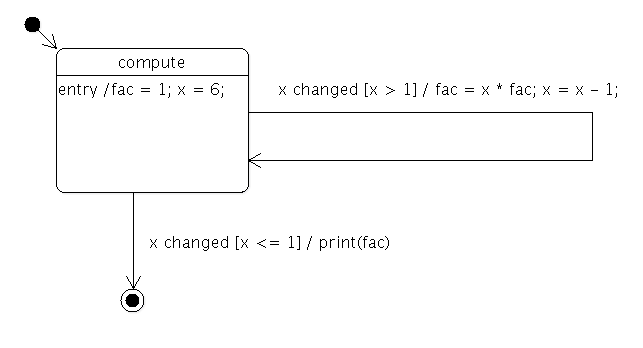
In other words, the state machine calculates the factorial of 6 and prints the result.
class Factorial : public QObject
{
    Q_OBJECT
    Q_PROPERTY(int x READ x WRITE setX)
    Q_PROPERTY(int fac READ fac WRITE setFac)
public:
    using QObject::QObject;
    int x() const
    {
        return m_x;
    }
    void setX(int x)
    {
        if (x == m_x)
            return;
        m_x = x;
        emit xChanged(x);
    }
    int fac() const
    {
        return m_fac;
    }
    void setFac(int fac)
    {
        m_fac = fac;
    }
Q_SIGNALS:
    void xChanged(int value);
private:
    int m_x = -1;
    int m_fac = 1;
};
The Factorial class is used to hold the data of the computation,
xandfac. It also provides a signal that’s emitted whenever the value ofx改变。class FactorialLoopTransition : public QSignalTransition { public: FactorialLoopTransition(Factorial *fact) : QSignalTransition(fact, &Factorial::xChanged), m_fact(fact) {} bool eventTest(QEvent *e) override { if (!QSignalTransition::eventTest(e)) return false; QStateMachine::SignalEvent *se = static_cast<QStateMachine::SignalEvent*>(e); return se->arguments().at(0).toInt() > 1; } void onTransition(QEvent *e) override { QStateMachine::SignalEvent *se = static_cast<QStateMachine::SignalEvent*>(e); int x = se->arguments().at(0).toInt(); int fac = m_fact->property("fac").toInt(); m_fact->setProperty("fac", x * fac); m_fact->setProperty("x", x - 1); } private: Factorial *m_fact; };The FactorialLoopTransition class implements the guard (
x> 1) and calculations (fac=x*fac;x=x- 1) of the factorial loop.class FactorialDoneTransition : public QSignalTransition { public: FactorialDoneTransition(Factorial *fact) : QSignalTransition(fact, &Factorial::xChanged), m_fact(fact) {} bool eventTest(QEvent *e) override { if (!QSignalTransition::eventTest(e)) return false; QStateMachine::SignalEvent *se = static_cast<QStateMachine::SignalEvent*>(e); return se->arguments().at(0).toInt() <= 1; } void onTransition(QEvent *) override { qInfo() << m_fact->property("fac").toInt(); } private: Factorial *m_fact; };The FactorialDoneTransition class implements the guard (
x<= 1) that terminates the factorial computation. It also prints the final result to standard output.int main(int argc, char **argv) { QCoreApplication app(argc, argv); Factorial factorial; QStateMachine machine;The application’s main() function first creates the application object, a Factorial object and a state machine.
QState *compute = new QState(&machine);
compute->assignProperty(&factorial, "fac", 1);
compute->assignProperty(&factorial, "x", 6);
compute->addTransition(new FactorialLoopTransition(&factorial));
computestate is created, and the initial values ofxandfacare defined. A FactorialLoopTransition object is created and added to the state.QFinalState *done = new QFinalState(&machine); FactorialDoneTransition *doneTransition = new FactorialDoneTransition(&factorial); doneTransition->setTargetState(done); compute->addTransition(doneTransition);A final state,
done, is created, and a FactorialDoneTransition object is created withdoneas its target state. The transition is then added to thecompute状态。machine.setInitialState(compute); QObject::connect(&machine, &QStateMachine::finished, &app, QCoreApplication::quit); machine.start(); return app.exec(); }The machine’s initial state is set to be the
computestate. We connect thefinished()signal to thequit()slot, so the application will quit when the state machine’s work is done. Finally, the state machine is started, and the application’s event loop is entered.
