Shows the basics of using
QVulkanWindow.Hello Vulkan 窗口范例 shows the basics of using
QVulkanWindowin order to display rendering with the Vulkan graphics API on systems that support this.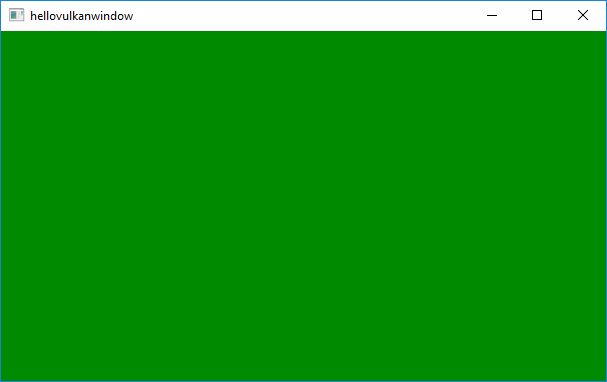
In this example there will be no actual rendering: it simply begins and ends a render pass, which results in clearing the buffers to a fixed value. The color buffer clear value changes on every frame.
Each Qt application using Vulkan will have to have a
												Vulkan


												instance
which encapsulates application-level state and initializes a Vulkan library.A
QVulkanWindowmust always be associated with aQVulkanInstanceand hence the example performs instance creation before the window. TheQVulkanInstanceobject must also outlive the window.QVulkanInstance inst; #ifndef Q_OS_ANDROID inst.setLayers(QByteArrayList() << "VK_LAYER_LUNARG_standard_validation"); #else inst.setLayers(QByteArrayList() << "VK_LAYER_GOOGLE_threading" << "VK_LAYER_LUNARG_parameter_validation" << "VK_LAYER_LUNARG_object_tracker" << "VK_LAYER_LUNARG_core_validation" << "VK_LAYER_LUNARG_image" << "VK_LAYER_LUNARG_swapchain" << "VK_LAYER_GOOGLE_unique_objects"); #endif if (!inst.create()) qFatal("Failed to create Vulkan instance: %d", inst.errorCode());The example enables validation layers, when supported. When the requested layers are not present, the request will be ignored. Additional layers and extensions can be enabled in a similar manner.
VulkanWindow w;
w.setVulkanInstance(&inst);
w.resize(1024, 768);
w.show();
Once the instance is ready, it is time to create a window. Note that
wlives on the stack and is declared afterinst.
To add custom functionality to a
QVulkanWindow, subclassing is used. This follows the existing patterns fromQOpenGLWindowandQOpenGLWidget. However,QVulkanWindowutilizes a separateQVulkanWindowRendererobject. This resemblesQQuickFramebufferObject, and allows better separation of the functions that are supposed to be reimplemented.class VulkanRenderer : public QVulkanWindowRenderer { public: VulkanRenderer(QVulkanWindow *w); void initResources() override; void initSwapChainResources() override; void releaseSwapChainResources() override; void releaseResources() override; void startNextFrame() override; private: QVulkanWindow *m_window; QVulkanDeviceFunctions *m_devFuncs; float m_green = 0; }; class VulkanWindow : public QVulkanWindow { public: QVulkanWindowRenderer *createRenderer() override; };
QVulkanWindowsubclass reimplements the factory functioncreateRenderer(). This simply returns a new instance of theQVulkanWindowRenderersubclass. In order to be able to access various Vulkan resources via the window object, a pointer to the window is passed and stored via the constructor.QVulkanWindowRenderer *VulkanWindow::createRenderer() { return new VulkanRenderer(this); } VulkanRenderer::VulkanRenderer(QVulkanWindow *w) : m_window(w) { }Graphics resource creation and destruction is typically done in one of the init - resource functions.
void VulkanRenderer::initResources()
{
    qDebug("initResources");
    m_devFuncs = m_window->vulkanInstance()->deviceFunctions(m_window->device());
}
QVulkanWindowsubclasses queue their draw calls in their reimplementation of . Once done, they are required to call backframeReady(). The example has no asynchronous command generation, so the frameReady() call is made directly from startNextFrame().void VulkanRenderer::startNextFrame() { m_green += 0.005f; if (m_green > 1.0f) m_green = 0.0f; VkClearColorValue clearColor = {{ 0.0f, m_green, 0.0f, 1.0f }}; VkClearDepthStencilValue clearDS = { 1.0f, 0 }; VkClearValue clearValues[2]; memset(clearValues, 0, sizeof(clearValues)); clearValues[0].color = clearColor; clearValues[1].depthStencil = clearDS; VkRenderPassBeginInfo rpBeginInfo; memset(&rpBeginInfo, 0, sizeof(rpBeginInfo)); rpBeginInfo.sType = VK_STRUCTURE_TYPE_RENDER_PASS_BEGIN_INFO; rpBeginInfo.renderPass = m_window->defaultRenderPass(); rpBeginInfo.framebuffer = m_window->currentFramebuffer(); const QSize sz = m_window->swapChainImageSize(); rpBeginInfo.renderArea.extent.width = sz.width(); rpBeginInfo.renderArea.extent.height = sz.height(); rpBeginInfo.clearValueCount = 2; rpBeginInfo.pClearValues = clearValues; VkCommandBuffer cmdBuf = m_window->currentCommandBuffer(); m_devFuncs->vkCmdBeginRenderPass(cmdBuf, &rpBeginInfo, VK_SUBPASS_CONTENTS_INLINE); // Do nothing else. We will just clear to green, changing the component on // every invocation. This also helps verifying the rate to which the thread // is throttled to. (The elapsed time between startNextFrame calls should // typically be around 16 ms. Note that rendering is 2 frames ahead of what // is displayed.) m_devFuncs->vkCmdEndRenderPass(cmdBuf); m_window->frameReady(); m_window->requestUpdate(); // render continuously, throttled by the presentation rate }To get continuous updates, the example simply invokes
requestUpdate()in order to schedule a repaint.
要运行范例从 Qt Creator ,打开 欢迎 模式,然后选择范例从 范例 . For more information, visit Building and Running an Example.
